
Four Art Business Lessons I Learned at Seventeen (From a Haunted Art Gallery)
Updated: Jul 30

(Missed Part 1? That’s the one where I was a summer camp counselor for the Parks & Rec department. Go catch up - I’ll wait.)
So, Parks & Rec turned out to be my accidental foot in the door. The city ran both the recreation department AND the local art gallery + museum, and when a job opened up over at the gallery, someone from Parks & Rec mentioned it to me. Because I already had a track record with the city, I had a little leg up on other applicants - proof, very early in life, that showing up and doing a decent job in one place has a funny way of opening doors in another. A lesson that would carry through any time I was in need of work or clients.
I got hired the autumn I turned seventeen. And I’ve got to say that I felt fancy.

Behind every “wow” is a lot of spackle; The Art Gallery
Art galleries are gorgeous because someone, somewhere, was on their hands and knees with a razor blade picking dried paint speckles off the carpet.
That someone was me.
Each exhibition got its own custom layout. There was a set of movable walls, and the curator would design the whole flow of the space - where you’d walk, where you’d pause, what you’d see first. A guy on staff (I think it was one guy? my memory of this is fuzzy - I was seventeen and mostly thinking about boys, my next day off, and what movie my friends and I would go see this weekend) would move the walls into position.
Then the gallery assistants - us - would paint them.
Every. Single. Time.
And it wasn’t always the same color, either. One show would call for pure white walls. The next would want a warm off-white. The next, a whisper of pale gray. Sometimes a single show would have different colors on different walls. So we’d spackle the holes left from the last hanging, sand it down, and repaint. Then we’d go around with razor blades and pick up the little paint specks that somehow made it onto the carpet even though - I swear - we must have used a tarp? Maybe? (If we didn’t, past me apologizes to the carpet.)
Although it was the paintings on the wall that received the praise from patrons, it was the walls themselves doing all of the heavy lifting. And those of us who painted and cared for the walls that made them possible. Every “effortless” gallery moment was built on hours of prep no one was ever meant to see.
The mailing list of all mailing lists - get one for our art business
Every show came with postcards - thousands of them - announcing the opening. Our job was to sit down and stick an address label and a stamp on every one of them, and then send them to be mailed.
Thousands. Of postcards. By hand.
When someone came into the gallery, we’d invite them to sign the guest book - name and address - so they’d get postcards for the next show. That guest book was, essentially, an email list before I knew what an email list was. Every signature was a future audience member. Every postcard was a gentle “hey, we’re still here, we made something new, come see it.”
I did not realize at the time that I was watching a marketing playbook for my art business unfold in slow motion. I thought I was just licking a lot of stamps.
Opening nights, clickers, and the art of not touching things
The opening night of a gallery show was always an event. Drinks, snacks, mingling. One of us always got assigned the clicker - the little manual counter you press every time someone walks through the door. (I liked the clicker. It was very satisfying. Don’t knock the clicker, it was old-school analytics.)
The rest of us circulated. We’d chat with guests, keep an eye out for anyone getting a little too enthusiastic with their proximity to a very expensive Monet, and gently remind people that no, they couldn’t take photos. It was hospitality and security and being pleasant company all at once.
Between openings, we worked regular gallery hours - signed people into the guest book, answered the phone, gave the occasional impromptu bit of information about a piece. Shows would run four to six weeks or so before the whole cycle started again.

The Western Hotel, and the ghost who lived there
Now. The other half of this job is where things get even more interesting and a little spooky.
The city also ran a small museum housed in an old hotel built in 1876. It’s tiny - maybe 3,000 square feet (if I were to guess, but keep in mind I’m terrible at guessing square footage, lol), two stories, more the size of a slightly-larger-than-average home than what you’d picture when someone says “hotel.” (You’d walk in today and think: “Oh. This is a small Victorian-style house.”)
It had been run by a woman named Myrtie Webber. Legend has it Myrtie fed the railroad workers - as many as three hundred men at a meal, morning and night - out of a kitchen that was bigger than a home kitchen but nowhere near what we’d call commercial today. Three hundred men. Twice a day. Out of what was essentially a slightly generous kitchen. I think about this often.
By the time I worked there, the place was a museum full of Myrtie’s things - her clothes, everyday objects from the era, artifacts from life in the desert in the late 1800s. We’d cover four-to-six-hour shifts, usually alone because foot traffic was slow. To pass the time, they had us type mailing labels on a real, honest-to-goodness typewriter. Mess up a letter? White it out. Try again. Clunk clunk clunk.
Sometimes a Girl Scout troop would come through and I’d give a tour, telling Myrtie’s stories, pointing out the good bits. Sometimes we’d host outdoor movie nights out back. I loved that job. I loved it so much.
I also, for the record, absolutely knew that place was haunted.
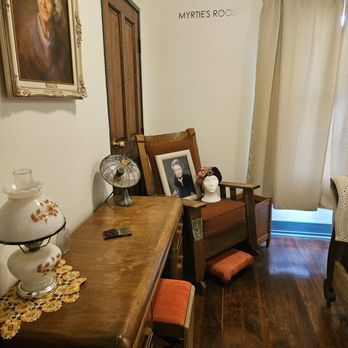
Exhibit A: The phonograph
There was a phonograph in the front parlor. No needle. No record. Everyone said it hadn’t worked in decades. One afternoon, I was at the front desk, typing labels — clunk clunk clunk - and music started playing… from the parlor.
I walked in. The sound was very clearly coming from the phonograph. Which still had no needle. And no record.

Exhibit B: The mystery breakfast
The old kitchen had been converted into our little break room - microwave, fridge, event supplies. One day I was there alone, and suddenly the whole place smelled like a full breakfast. Biscuits. Gravy. Meat. Real, warm, someone-cooked-this-with-love kind of smell.
I went to check. No food. No one cooking. No one there.
It smelled incredible though. Ten out of ten. Would be haunted by that meal again.

Exhibit C: Myrtie
Closing up in winter was my least favorite part of the job. The museum closed around dusk, and I had a whole ritual: upstairs first, back room first, check every window while the lights were still on (because I am a fraidy cat), and THEN turn the lights off on my way out. I’d reach into each room from the hallway, flick the switch, and basically Scooby-Doo my way down the hall on hardwood floors trying to reach the stairs before the dark could catch up to me.
The stairs were those tiny old-fashioned ones. They barely fit a whole foot. It made it easy to sort of slide down the fronts of the stairs vs. take each one carefully.
One night, I hit the top of the stairs and felt it - the cold-down-your-spine, hair-standing-up-on-your-arms feeling. I slid down those stairs like a cartoon character skating on ice. Got to the bottom. Felt someone at the top. Every instinct said don’t look back.
I looked back.
There was Myrtie. Clear as day, standing at the top of the stairs. I could see her face, her clothes, everything about her - but she was slightly translucent, in that way where you can’t really see through her but she isn’t quite solid either. It’s hard to explain unless you’ve seen a full apparition.
I told her, out loud, standing at the bottom of the stairs: “I don’t mean you any harm. I have no bad intentions here. I hope you don’t either.”
Then I grabbed my keys, ran out, locked up, and sat in my car breathing like I’d finished a 5K.
After that, somehow, I felt more at peace there. Still spooked. But more at peace. We had reached an understanding, Myrtie and I.

Bonus haunting: the mannequin room
The gallery had a supply space in a building called the Cedar Center — a place that had, in previous lives, been many things, including at one point a hospital, and at another point an insane asylum. The downstairs had been converted into a small theater. The upstairs was still lined with the tiny old doctor’s offices and patient rooms.
We stored props over there. Including a room full of mannequins.
And when I say “full,” I mean this ten-by-ten little room was mannequin on mannequin on mannequin, all piled together like the world’s most unsettling group nap.
One day I was sent over to grab a mannequin for a show. I walked upstairs. Every door in the hallway was closed and padlocked shut. I unlocked the mannequin room, stepped inside, and heard a boom - a huge, loud one. I stepped back out and looked down the hallway.
Every single padlocked door was open!!
I did not get the mannequin. I did not go back for the mannequin. I told my boss someone else could get the mannequin. I wasn’t going back in there.
Feeling very fancy for seventeen
Most of my friends had waitressing gigs or worked retail or fast food, all of which are honest, hard, respectable jobs. But my job? My job had me standing three feet from a Monet. Or a Rembrandt. Or a piece by a local artist next month. Or something brought in from a gallery in Los Angeles or New York.
I got to see how a show is built from the walls out. I got to watch an audience get invited into a space through nothing more than a postcard in the mail. I got to give tours in a haunted museum where a woman named Myrtie occasionally reminded me she still lived there. I got trusted with keys and cash drawers and closing shifts at seventeen and eighteen years old.
I felt lucky. I still feel lucky.
The receipts
Everything I do now - the branding, the presentation, the mailing lists, the events, the wearing of fourteen hats before lunch, the trust that I can figure it out because I’ve been figuring it out since I was seventeen (fifteen really when you count my parks and rec job) - a lot of that started in a small-town gallery with a paint roller in one hand and a razor blade in the other. And it kept going in a tiny museum where a very patient ghost let me clock in and out.
If I had to write it out in four lines, the lessons I learned from this fancy job were these:
The magic isn't the art. It's the freshly painted wall you never notice behind it.
Your mailing list is your business. Start it before you think you need it.
The person who can do a little bit of everything is very hard to knock over.
And the self-trust you build at seventeen - or fifteen, or forty-two - is the same self-trust that lets you bet on your art later.
More receipts to come.
(And Myrtie, if you’re reading this from the great beyond: still no bad intentions. Miss you. The biscuits smelled amazing.)


Comments