
Art Marketing Strategies That Actually Work: A Practical Guide for Creative Entrepreneurs

The art world has changed dramatically in the past decade. Gone are the days when artists had to rely solely on gallery representation or local craft fairs to get their work seen. Today, you have more control than ever over how you market your art – but with that freedom comes the challenge of figuring out where to start.
I've spent years building The Yellow Studio and testing what works (and what definitely doesn't) when it comes to marketing art online. This guide is packed with actionable strategies you can implement today, whether you're just starting out or looking to level up your existing art business.

Understanding Your Audience Before You Market
Before you dive into any marketing strategy, you need to know who you're talking to. This isn't about creating some fictional "ideal customer avatar" exercise – it's about understanding the real people who connect with your work.
Look at your existing sales and engagement. Who's buying? Who's commenting? Who's sharing your posts? These patterns tell you everything. If your nostalgic designs are getting traction, lean into that. If your humor-based products are flying off the shelf, that's your signal.
AI can help here too. Tools like ChatGPT or Claude can analyze your sales data and help you identify patterns you might miss. Upload your shop analytics and ask for insights about your best-performing products, peak buying times, and customer behavior trends.

Pinterest: Your Most Underrated Marketing Tool
If you're not using Pinterest strategically, you're leaving money on the table. Pinterest isn't social media – it's a visual search engine where people go specifically looking for things to buy, ideas to implement, and inspiration to act on.
The beauty of Pinterest for artists is that it keeps working long after you post. A pin you create today could drive traffic to your shop for months or even years. Compare that to Instagram, where your post gets buried in a few hours.
Create pins for every product you launch. Show your art in context – on a wall, on a person, in a lifestyle setting. Use keyword-rich descriptions and board names. Pin consistently, but quality matters more than quantity. And remember, vertical images (9:16 ratio) perform best.
AI tools like Canva's Magic Write can help you generate Pinterest-optimized descriptions quickly, saving you time while ensuring your pins are search-friendly.

Email Marketing: Your Direct Line to Buyers
Your email list is the only marketing channel you truly own. Social media platforms can change their algorithms or shut down tomorrow, but your email list stays with you.
Start building your list from day one. Offer something valuable in exchange for an email address – a free downloadable print, a discount code, or access to exclusive designs. Then actually use that list. Send regular newsletters sharing new products, behind-the-scenes content, and personal stories.
The artists who succeed with email aren't the ones who only email when they want to sell something. They're the ones who build genuine relationships. Share your creative process. Talk about what inspires you. Let people into your world.
AI can be your email marketing assistant. Use it to brainstorm subject lines, generate newsletter ideas, or even draft emails that you then personalize with your own voice and stories. You can even have AI help you plan what types of content to share in your newsletters to create weekly, bi-weekly, or monthly themes.

Social Media: Choose Your Platform Wisely
You don't need to be on every platform. In fact, trying to maintain a presence everywhere is a recipe for burnout. Pick one platform where your ideal customers actually hang out and go deep there. If you get to the point where you feel confident about your posting schedule and traction, then add another platform over time.
TikTok and Instagram Reels are incredible for artists right now. Short-form video lets you show your process, tell stories, and connect with people in ways static images never could. You don't need fancy equipment – your phone and natural lighting work beautifully.
Show your art being created. Share mistakes and how you fixed them. Talk about what inspired a piece. Give people a reason to care about you as a person, not just your products. People don’t just buy art, they buy into the artist!
Don't forget about the power of text-based designs on social media. Quick, quotable graphics perform exceptionally well and are easy to batch create. Pair those phrases with cut-outs from your original artworks and you have a recipe for scalable success.
AI video tools like Vizard can help you repurpose longer video content into social-ready clips, while AI writing assistants can help you brainstorm captions that actually stop the scroll.

Content Marketing: Become a Resource, Not Just a Seller
Blogging isn't dead – it's just evolved. When you create helpful content around topics your audience cares about, you build trust and authority. You become the go-to person in your niche.
Write about things your ideal customers are searching for. If you create animal-themed art, write guides about choosing pet gifts or decorating with animal prints. If you make nostalgic designs, write about Y2K trends or childhood memories. You can also write blogs about the “why” of your art – what inspired you, who you were thinking of, and how you created a specific piece of art. Write about a series of artworks you created and tell the story of how they came to be. Every piece of content is an opportunity to naturally link to relevant products.
Search engines love comprehensive, helpful content. The more valuable resources you create, the more likely people are to find you when they're looking for exactly what you offer.
AI can help you research topics, outline posts, and even draft sections – but always add your personal experience and unique perspective. That's what makes content truly valuable. A little tip I love to give on blogging with AI is to do a stream-of-consciousness style brain dump of your thoughts on the subject you’d like to blog about. Then ask AI to help you write a clear, cohesive blog about what you just wrote. Take some time to make a few edits afterward to make sure it’s in your exact voice, and voila, a blog is born more quickly than having to stare at the blank page, wondering how to write what you’d like to say.
Product Photography That Sells
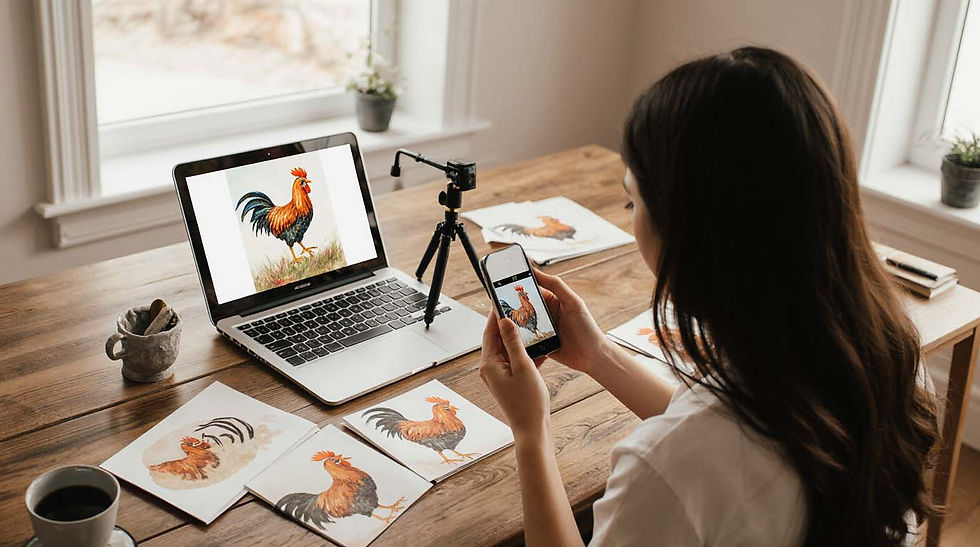
Your product photos are doing heavy lifting in your marketing. They need to show not just what your art looks like, but how it fits into someone's life.
Invest in good mockups or create lifestyle photos showing your products in real settings. A mug on a white background is fine, but a mug on a cozy desk with morning light streaming in tells a story. Stories sell.
Show scale by including items for reference. Show details with close-ups. Show multiple angles. The more completely someone can envision owning your product, the more likely they are to buy it.
AI image generators like Midjourney can help you create stunning lifestyle backgrounds or
conceptual images for your blog posts and social media, complementing your product photography with scroll-stopping visuals.

Collaboration and Cross-Promotion
Other artists aren't your competition – they're your community. Collaborating with creators in complementary niches expands your reach to audiences that already appreciate handmade and creative products.
Look for artists whose style complements (not copies) yours. Partner on giveaways, bundle promotions, or Instagram takeovers. Share each other's work genuinely. The rising tide lifts all boats.
Join artist communities online and actually participate. Don't just drop links – add value, answer questions, celebrate others' wins. The connections you make can lead to unexpected opportunities.

SEO Basics for Artists
Search engine optimization isn't just for blogs. Your product titles, descriptions, and tags all impact whether people can find your work when they search.
Use descriptive, specific language. Instead of "Blue Art Print," try "Celestial Moon Phases Wall Art Print - Astrology Inspired Home Decor." Think about what someone would type into Google if they were looking for your exact product. One of my best-selling items is titled “Blue-Green Peacock Tankini Top”. If someone is looking for peacock tankinis, mine might be one of only a few out there (if not the only one).
Include relevant keywords naturally in your shop descriptions, about page, and product listings. But write for humans first, search engines second. Keyword-stuffed gibberish turns people off.
Alt text on images matters too – it helps with accessibility and SEO. Describe what's actually in the image in a clear, natural way. Have AI write the alt text for you by uploading your image to your favorite LLM and asking for alt text for it.

Paid Advertising: When and How to Invest
Paid ads aren't necessary when you're starting out, but they can accelerate growth once you have a proven product and understand your audience.
Start small. Test Pinterest ads first – they're typically more affordable than Instagram or Facebook ads and reach people actively searching for products. Set a modest daily budget ($5 per day) and track what actually converts.
The key is having a strong organic foundation first. If your free marketing isn't working, paid ads will just put more money behind something that isn't resonating. Use your organic content to test the waters on which content performs the best and then boost that top performing content.
Use AI tools to help generate ad copy variations for A/B testing, but always review and refine based on your brand voice.

Analytics: Let Data Guide Your Decisions
You can't improve what you don't measure. Check your analytics regularly – not obsessively, but consistently. Checking them once per week when first starting out is a great idea and then once a month when you have things more dialed in. Look at what's working and do more of it.
Which products get the most views but don't convert? Maybe the price point is wrong or the photos need work. Which traffic sources bring buyers versus just browsers? Double down on what's working.
Google Analytics, Pinterest Analytics, and your shop platform's built-in stats all tell part of the story. Look at them together to see the full picture. You can use tools like Metricool to track your analytics all in one place. They have free options and an upgrade of $10/mo. gets you a pro account.
AI can help you make sense of complex data by identifying patterns and suggesting optimization strategies based on your numbers.

Seasonal Planning and Trend Forecasting
Smart marketing means planning ahead. Holiday designs need to be ready months in advance. Seasonal products should launch before the season starts, not during it. A good rule of thumb is to plan products the quarter prior to the season. Create products for summer in January-March, Back to School in April-June, Autumn & Halloween products during July-September, holiday items in July-September, and Valentine’s Day products during October-December.
Pay attention to what's trending in fashion, home decor, and pop culture. Not to copy, but to understand what resonates with people right now. Then interpret those trends through your unique artistic lens. Or choose pieces from your catalogue of work that fit those trends.
Create a content calendar that maps out product launches, blog posts, and promotional campaigns. This doesn't mean you can't be spontaneous – it just means you're not constantly scrambling.

The Long Game: Building Brand Loyalty into Your Art Marketing Strategy
The best art marketing strategy is creating work people love and treating customers like the sweet friends they are. When someone buys from you, that's the beginning of a relationship, not the end.
Follow up with thank you notes. Ask for feedback. Create a loyalty program or early access for repeat customers. Make people feel valued and they'll become ambassadors for your work.
Your brand is more than your logo or color scheme – it's how you make people feel. At The Yellow Studio, I’m all about encouragement, community, and helping artists build sustainable creative businesses. Every interaction reinforces that.

Keep Creating, Keep Marketing
Marketing your art isn't separate from making art – it's part of the creative process. It's how you share your vision with the world and connect with people who need exactly what you make.
The artists who succeed aren't necessarily the most talented – they're the most consistent. They show up, they share their work, they keep learning and adapting. They use every tool available, including AI assistants, to work smarter and reach further.
At The Yellow Studio, we believe in building creative empires one smart decision at a time. Marketing doesn't have to feel sleazy or overwhelming. It's simply showing your work to people who'll love it. And with the right strategies in place, you can spend less time marketing and more time creating.


Comments